
Long-distance caregiving fails in predictable ways. Here is where the information breaks down, and what actually fixes it.
Southern Arizona has a large population of retirees whose adult children live somewhere else entirely — often several time zones away. It is one of the most common situations families call about, and it fails in fairly predictable ways.
The information problem
You are managing your parent's healthcare through a telephone, and every piece of information reaches you secondhand. Your mother reports that the appointment "went fine." Whether it went fine is not something she can reliably assess, and if she did not follow all of it, you have no way of knowing which part she missed.
Meanwhile, the medical picture is genuinely accumulating. Prescriptions get added by different prescribers. A fall in the spring never gets mentioned. Records sit in one practice's system and never reach another. By the time something forces the issue, nobody — not you, not your parent, not any single physician — holds the whole picture.
Why flying in does not solve it
Visiting helps, but it tends to be episodic and badly timed. You arrive for a week, try to compress months of catching up into a few appointments, and leave. Or you fly in during a crisis, with no context, and have to reconstruct the history from scratch in a hospital corridor.
What is actually missing is not your presence. It is continuity — someone locally who knows the history, attends the appointments, and reports back accurately.
What continuity looks like in practice
An RN patient advocate in Tucson does three things that address this directly.
Attends appointments in person. A Registered Nurse in the room means the right questions get asked and the plan is understood before anyone leaves. It also means your parent is not the sole record of what was said.
Sends a written summary, then calls. You get an account of what happened — what was discussed, what changed, what comes next — rather than a reassurance. This is the piece long-distance families consistently say makes the largest difference.
Holds the record. Obtaining previous medical records and formulating one medical summary for all the physicians on the case means the fragmentation stops compounding. So does a medication review for potential interactions, particularly once several prescribers are involved.
A note on your parent's autonomy
Adult children sometimes hesitate because bringing in an advocate feels like taking something away. In practice it usually does the opposite. One of the stated aims of ongoing advocacy work is assisting the client to become independent in their own care. A parent who understands their own medications and has a clear plan is more independent, not less — and less likely to have decisions made around them during an emergency.
Starting small
You do not have to hand over everything at once. Many families begin with something narrow: a medication review, or getting scattered records assembled into a single summary. It is a low-stakes way to find out whether the arrangement works for your parent.
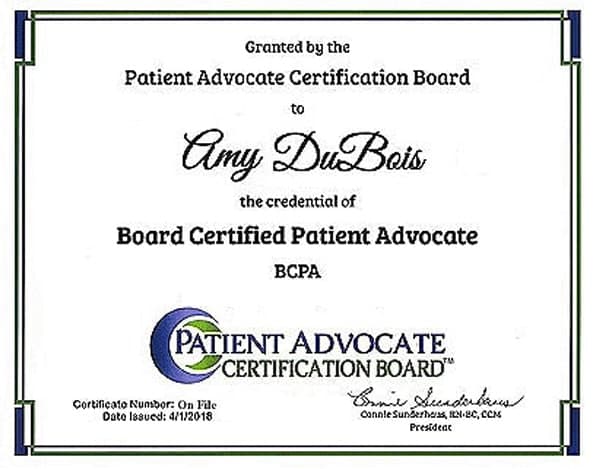
Amy DuBois, RN, BCPA, serves Tucson, Oro Valley, Marana, Sahuarita, Green Valley and Tubac. Call 520-909-8203 — the first consultation is free.
- long-distance caregiving
- aging parents
- Tucson