
Specialist appointments are short and dense. A small number of questions reliably produce more clarity than any others.
Most people leave a specialist appointment with a fraction of what was said, and think of their real question on the drive home. That is not a failing of attention. The appointment is fifteen minutes, the vocabulary is unfamiliar, and you are often frightened — which is precisely when complex information is hardest to absorb.
A short list of questions, written down beforehand, reliably produces more clarity than trying to keep up in the moment.
About the diagnosis
- What is the name of this condition, and can you write it down?
- How certain are you? Is anything still being ruled out?
- What caused it, as far as you can tell?
Getting the name written down matters. Half the confusion in later appointments comes from a family repeating an approximation of a term they half-heard once.
About the options
- What are the options, including doing nothing for now?
- What would you expect to happen with each one?
- Which would you recommend, and why that one?
That last question is worth asking directly. Clinicians often present options neutrally out of respect for patient choice, which can leave patients guessing at a recommendation that the doctor would happily give if asked.
About the practicalities
- What does this involve week to week — appointments, recovery, driving, help at home?
- How will we know whether it is working?
- What should prompt me to call you before the next appointment?
About the medication
- What is this for, and what should I notice if it is working?
- Does it interact with anything else I take? (Bring the full list, not a summary.)
- How long am I on it, and who reviews that decision?
About who else needs to know
- Will you write to my primary care physician, and to my other specialists?
- Who is responsible for booking the follow-up — you or me?
- Who calls me about the test results, and by when should I chase it?
These are the questions that prevent the most common failure in multi-specialist care: each doctor managing their piece competently while nobody holds the whole.
Two practical habits
First, write the questions down and hand the list over at the start rather than producing it at the end. It sets the agenda while there is still time.
Second, bring someone. Two people hear more than one, and the second person is not the one absorbing news about their own body.
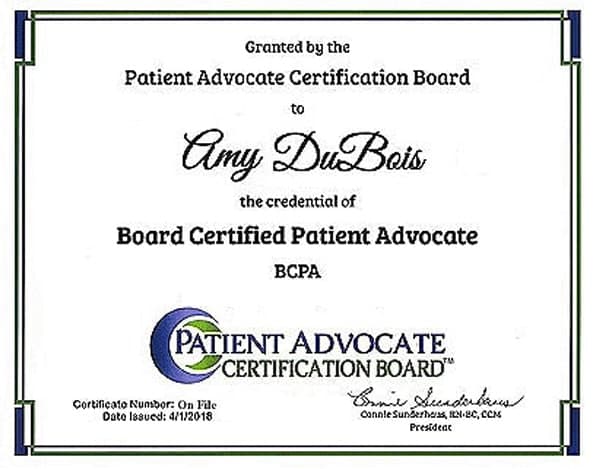
That is a large part of what an RN patient advocate does — accompanying clients to appointments to ensure the questions are being asked and that the plan is understood, then providing a written summary afterward. Amy DuBois, RN, BCPA, does this for families throughout Tucson and Southern Arizona. Call 520-909-8203.
- appointments
- specialists
- practical guides