
Patient advocacy is largely unregulated. Board certification is one of the few objective markers available, and it is worth understanding what it does and does not tell you.
Here is something worth knowing before hiring anyone in this field: in most of the United States, "patient advocate" is not a licensed or regulated title. Nobody has to prove anything to use it. That is not a scandal — it is simply the state of a young profession — but it does place the burden of checking on you.
What BCPA is
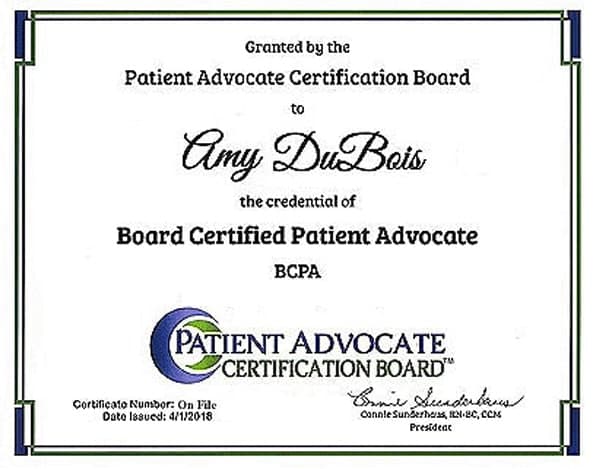
BCPA stands for Board Certified Patient Advocate. The credential is granted by the Patient Advocate Certification Board, an independent body established to create a defensible standard in a field that had none. Certification requires meeting education and experience requirements and passing an examination covering the competencies the role actually demands.
Amy DuBois earned the BCPA credential on .
What it tells you
It tells you the person has been assessed against an external standard rather than self-declaring competence. In a field where anyone can print a business card, that is a meaningful filter.
It also signals a commitment to the ethical spine of the work — chiefly that the advocate serves the client's interests, and is transparent about anything that could compromise that.
What it does not tell you
Certification is not clinical training. This is where the distinction matters most, and where the two credentials to check are different things.
A BCPA may or may not have a clinical background. An RN patient advocate is a Registered Nurse — someone who has spent years in clinical practice, can read a chart, understands what a lab value implies, and knows how a hospital actually functions from the inside rather than from the visitor's chair.
Amy DuBois holds both: a Registered Nurse of more than thirty years, including acute hospital nursing in Baltimore and Washington, DC, followed by home health nursing, case management and hospital liaison work in Tucson — plus the BCPA credential.
What else to check
Beyond credentials, a few questions are worth asking anyone you are considering.
- Who pays you? The answer should be: the client, and only the client. An advocate taking referral fees from facilities has a conflict, whatever the credential.
- What is your clinical background? Ask for specifics — where, how long, what kind of nursing.
- Do you work in the hospitals I use? Local familiarity is genuinely useful. Knowing how referrals move in a particular system saves weeks.
- What do I actually receive? A written summary after each appointment is a reasonable expectation, not a premium extra.
A reasonable standard
You are inviting someone into the most private part of your life at a moment when you are not at your strongest. Asking to see the credential is not rude. Anyone worth hiring will be pleased you asked.
Amy DuBois, RN, BCPA, serves Tucson and Southern Arizona. Call 520-909-8203 — the first consultation is free.
- credentials
- BCPA
- choosing an advocate