
Medication lists accumulate quietly across multiple prescribers. Here is how that happens, and why a periodic review is worth doing.
Almost nobody sets out to be on nine medications. It happens gradually, one reasonable decision at a time, across several prescribers who each see one part of the picture.
How lists grow
A cardiologist starts something. Two years later a rheumatologist adds another, reasonably, for a different problem. A hospital stay changes two more and stops one — and the stop never propagates back to the prescriber who originally started it. Somewhere in there, an over-the-counter supplement joins the list without ever being mentioned to anyone, because it did not feel like a medication.
Every one of those decisions was defensible in isolation. The list as a whole may not be, and the striking thing is that often nobody has ever looked at it as a whole.
Why nobody reviews it
Each specialist is responsible for their own prescriptions and reasonably assumes someone is holding the overall picture. Primary care physicians are often best placed to do it, but a fifteen-minute appointment for a specific complaint is not where a full reconciliation happens. Pharmacists catch a great deal, but only across prescriptions filled in the same place.
The gap is real, and it is largest for exactly the patients where it matters most: older adults with several conditions and several prescribers.
What a review actually looks at
A medication review by a Registered Nurse covers more than the interaction checker in a pharmacy system.
- Interactions. Not only drug-to-drug, but the accumulated effect of several medications that each nudge in the same direction — sedation, blood pressure, bleeding risk.
- Duplication. Two drugs from the same class started by different prescribers, or a brand and a generic of the same thing.
- Still needed? Medications started for a temporary reason that quietly became permanent, because no one owned the decision to stop.
- Understanding. Whether the person taking them knows what each one is for. A patient who does not know why they take something is far more likely to stop it silently, or to keep taking something that was meant to stop.
When to do it
Three moments are worth catching: after a hospital stay, when a new specialist joins the picture, and periodically once the list passes about five medications. After a hospital stay is the most urgent — that is where the largest number of changes happen in the shortest time.
What to bring
Bring the actual bottles, not a written list. Lists are aspirational; bottles are what is being taken. Include over-the-counter medicines, supplements, vitamins and anything prescribed by a dentist or eye doctor. And say honestly if something is not being taken as prescribed — that is data, not a confession.
Getting one done
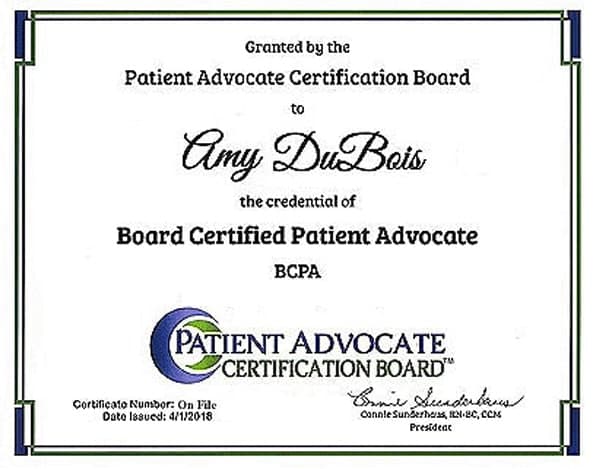
Medication review for potential interactions, along with education for the client about their medicine, is one of the ongoing services Amy DuBois, RN, BCPA, provides across Tucson, Oro Valley, Marana, Sahuarita, Green Valley and Tubac. It is also one of the easiest places to start if you are unsure whether an advocate would be useful at all.
Call 520-909-8203.
- medications
- safety
- older adults